We are living in an era where the barrier to offering professional advice has completely collapsed. On modern platforms, visibility is routinely mistaken for competence, and the volume of a claim is rewarded far more than its substance.
Every serious professional discipline rests on a simple principle: competence must precede counsel.
In medicine, engineering, or law, no one expects a practitioner to teach before they have spent years mastering their craft through structured practice, trial, and error. High-value B2B selling requires the same standard. Guiding younger professionals should be about transferring insights that have been tested against complex commercial realities – not merely about sharing perspectives.
It has become easy to distribute frameworks that sound compelling in theory but lack operational depth. Scripted tactics assume a linear buying process. In reality, enterprise sales involve competing internal agendas, shifting budgets, and organisational risk. These techniques cannot substitute for the ability to read a room, assess stakeholder anxiety, and adapt strategy in real time.
Having access to information is not the same as possessing the judgment required to apply it. When early-career professionals are taught to rely on surface-level formulas, they will miss the foundational understanding needed to build enduring client relationships.
True insight is earned at the negotiating table, by navigating difficult client committees, handling complex project implementations, and managing professional accountability. Mentorship should always stem from verified, lived practice.
Commercial mastery is deliberate, rigorous, and refined over time. When we anchor sales education in substantive experience and intellectual rigour, we give the next generation of sales professionals the tools to build sustainable, high-impact careers.
If this is of interest let’s connect. Drop me a message or leave a comment below.
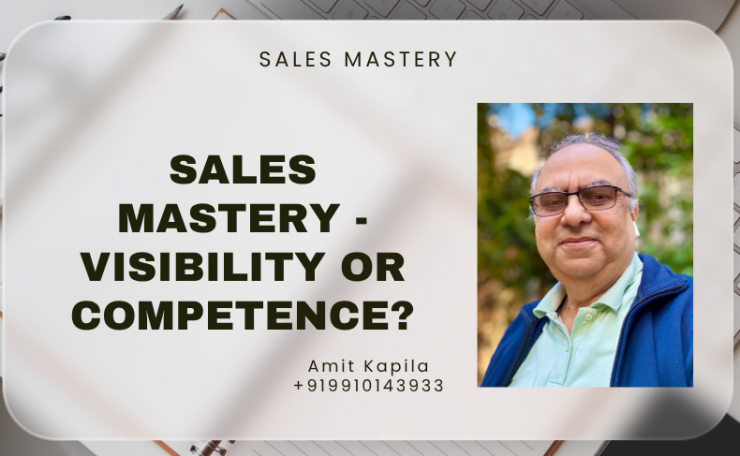
Sales Mastery – Visibility or Competence?